Winston Churchill: An Informal Study of Greatness by Taylor Robert Lewis
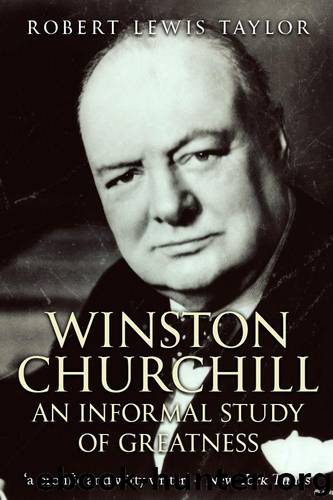
Author:Taylor, Robert Lewis [Taylor, Robert Lewis]
Language: eng
Format: epub
Publisher: Endeavour Press
Published: 2016-11-20T23:00:00+00:00
Chapter 17
CHURCHILL’S reputation as a wit in Commons began in connection with one of his departures from Tory principles. He had not been seated a month before it was evident that his tastes were frequently to run counter to those of his party leaders. Not only did he advocate a soft peace for the Boers, who were doggedly holding out against the best military brains Britain could muster, but he created an uproar by savagely attacking a proposed high military budget. It was no wonder that Brodrick, the War Minister, confused Churchill with his father, for this last measure was the very one against which Lord Randolph had shattered his best lances. But it was the question of Free Trade that separated Churchill with real emphasis from his fellow Conservatives. When Joseph Chamberlain abandoned the historic laissez-faire policy for tariff protection, with particular reference to Birmingham industries, Churchill arose in the House and said, “Mr. Chamber-lain loves the workingman, he loves to see him work.”
As his father had done, the hero of Pretoria steered a small group of dissidents away from the official party course. They included Ian (later Sir Ian) Malcolm, Lord Hugh Cecil, and Ivor Guest (later Lord Wimborne), Churchill’s cousin, and were much relished by the press, which referred to them by various nicknames worked out from the names of the participants — “Malcolmtents,” “Hughligans,” etc. Churchill became so exercised about Free Trade and the workingman that he was scarcely distinguishable from his old running mate, the late Mawdsley. He took his best friend, Hugh Cecil, and spent the summer of 1903 barnstorming directly on the heels of Joseph Chamberlain, who was speaking from town to town in favor of “Free Trade Within the Empire.” The fact that the Hughligans were coming up astern was said to have nettled Chamberlain to the point where he forsook his message and spent most of his time preaching about the immature absurdities of Churchill, whom he took to be the instigator of practically everything troublesome in that era. The net result of this was very beneficial to the mop-up pair; Chamberlain’s blasts acted as a kind of preliminary billing; he was cast in the role of advance man, like Frank Braden with the Ringling Brothers Circus.
By the time Churchill and Cecil reached a town, everybody was stimulated to receive them, sometimes with cheers and encouragement and occasionally with ropes. They were almost lynched in Birmingham, Chamberlain’s native city. Birmingham was a traditionally impulsive spot, from which Lloyd George, after a pacifist rally, had recently withdrawn in safety only by donning a policeman’s uniform. Warned that a genuinely hostile crowd was planning a necktie party, in the Western term, Churchill drove his carriage into the midst of the people, lit a cigar, got down leisurely, and made a path to the speaking platform, puffing away as serenely as if he had been in the Carlton Club. At first stunned, the crowd finally relaxed and then cheered him in admiration.
Churchill had some club trouble on this trip.
Download
This site does not store any files on its server. We only index and link to content provided by other sites. Please contact the content providers to delete copyright contents if any and email us, we'll remove relevant links or contents immediately.
| Anthropology | Archaeology |
| Philosophy | Politics & Government |
| Social Sciences | Sociology |
| Women's Studies |
The Secret History by Donna Tartt(19088)
The Social Justice Warrior Handbook by Lisa De Pasquale(12190)
Thirteen Reasons Why by Jay Asher(8910)
This Is How You Lose Her by Junot Diaz(6887)
Weapons of Math Destruction by Cathy O'Neil(6280)
Zero to One by Peter Thiel(5802)
Beartown by Fredrik Backman(5754)
The Myth of the Strong Leader by Archie Brown(5507)
The Fire Next Time by James Baldwin(5446)
How Democracies Die by Steven Levitsky & Daniel Ziblatt(5218)
Promise Me, Dad by Joe Biden(5153)
Stone's Rules by Roger Stone(5088)
A Higher Loyalty: Truth, Lies, and Leadership by James Comey(4964)
100 Deadly Skills by Clint Emerson(4925)
Rise and Kill First by Ronen Bergman(4789)
Secrecy World by Jake Bernstein(4753)
The David Icke Guide to the Global Conspiracy (and how to end it) by David Icke(4719)
The Farm by Tom Rob Smith(4511)
The Doomsday Machine by Daniel Ellsberg(4490)
